

When I talk to someone I haven’t seen for a while, inevitably, their first two questions are: “How’s the winery?” and “When can I buy your wine?” I watch their eyes light up, envisioning the dream I’m pursuing with my partners on Foretold.
The dream looks a bit different up close.
We don’t own a winery. Replace grand visions of a sweeping tasting room, production floor and cellar with a single plot of land. We own a vineyard — one acre, nestled in the heart of Argentina’s Uco Valley. It’s stunningly beautiful and surprisingly small.

The answer to the second question, “When can I buy your wine?” is the trickiest question of all.
The Journey
Our Foretold wines have been on a journey. In March, they bid farewell to their Argentine brothers and sisters, traversed the Andes to the Chilean coast, then set sail for America. The journey was long, the accommodations threadbare. Tucked into a shipping container, they laid down for months as they traveled north along the western coast of the Americas.
Today, our wines sit docked at a port in Los Angeles, waiting to clear customs. What happens next hinges on the persistence of four dreamers and the insanities of the three-tier distribution system.
Charting the Course from Textbook to Reality
In the years of study for my WSET Level 4 Diploma, I learned a lot about the three-tier distribution system. During theory exams, I scribbled away frantically in handwritten essays that described the system and its implications in detail. I really knew my stuff. Or so I thought.
On paper, the three-tier distribution system consists of: an importer, a distributor, a retailer. The importer is responsible for navigating the wine’s transition from its country of origin to its destination. The distributor is responsible for selling wine into wine shops and restaurants. The retailer sells wine on premise (read: in a restaurant or bar), off premise (read: at a wine shop or liquor store), or directly to the consumer. Simple, right? Yeah, not so much.
In reality, the system is far more complex. Unique to America, the three-tier system is just one of many global systems to regulate the production, distribution, and sale of wine. Within the American three-tier system, each state has its own rules. Want to buy wine in a grocery store in Utah? Not gonna happen. Want a winery to ship directly to your door? In Rhode Island, only if you’ve physically visited the winery first. Want to buy online? Not in Delaware. State-level nuances abound.
Added layers of challenge arise for small producers like ourselves. What my WSET studies alluded to, but I couldn’t fully appreciate, was just how stacked the odds are for a small, imported brand trying to break through. According to USA Wine Ratings, three companies dominate U.S. wine distribution, and the top ten distributors control over 81% of the market. Large distributors prioritize volume and name recognition over new entrants. Wave after wave of distributor consolidation leaves small producers like ourselves with limited options. As The Drinks Business reported earlier this year, for producers outside the top-volume tier, fewer distributors means fewer options, less leverage, and less likelihood that anyone in the three-tier chain has a financial incentive to tell their story.
As a foreign producer, we also can’t simply walk our wine into a U.S. distributor ourselves. A U.S.-based importer must step in as the legal first-tier entity, taking title to the wine and handling federal registration, including obtaining a Certificate of Label Approval for every label before customs will release a single bottle. That process typically takes up to 15 business days. Hence our impatient wines docked in LA.
As my partners and I began wrapping our heads around these hurdles, we sought input from anyone and everyone that might help. I reached out to every distributor I knew. LeVon pitched our brand to a local restaurant. Nicole dug through her seemingly endless connections (she is known as “the mayor of Los Angeles” in some circles). Bekka and I popped by our local wine shop to sell our wares. We worked all of our angles.
At our local wine shop, I regularly nerd out on wines with Grant, the store manager. His eyes light up when I come in and ask him to surprise me. Once, he hurried down into the cellar to unearth a 30-year-old bottle of Riesling, bounding back up the stairs with effusive commentary. He’s always eager to lean in.
When it came to our wines, he was equally game, offering to sell them in the store once we identified our distributor. He walked us through the pricing structure and the store’s cut.
Nicole’s research led us to a distributor and a DTC shipper, friends of a friend. “Once the mayor, always the mayor,” Bekka noted of her partner’s vast network. Both of Nicole’s contacts were eager to help. Each explained their cut.
Detour: Math
You know how this story ends. Everyone gets a cut. Our little wines begin their journey at the vineyard, where we pay to tend to the vines and make the wines. They end up in the bottle, where costs vary based on bottling and labeling preferences. They trot off to the shipping container, where we pay for freight. They arrive in the states, where the importer takes their cut. The distributor takes their cut. The retailers (on premise, off premise, direct to consumer) take their cuts. And let’s not forget the federal and state taxes along the way.
I’ll spare you the numbers and get down to the sum of it all: by the time our wine reaches your glass, the fraction that finds its way back to Foretold would make you gulp.
Cut back to the dreamy-eyed question I often field: “Are you going to quit your job and do this for a living?” Nope. That math doesn’t math.
Getting Lost in the Details
If I had a dollar for every time my partners or I said “I really don’t understand…” or “I’m not sure how this works…” or “We need more clarity…” or “How exactly are we going to do this…,” I probably could retire off of our wine business.
I’m also not an operator. Vision, brand, taste — those are my strengths. As our logistics have mounted, I’ve often found myself blank-faced and dopey-eyed, wondering how the hell we move forward.
Thankfully, I’m not alone.
I’m surrounded by the strengths of my partners. Bekka: the owner and operator of a multi-generation family art business; a hustler; someone who gets shit done. Nicole: the owner of her own business in TV production and brand integration; a wheeler and dealer; a former accountant with a secret love of Quickbooks. LeVon: the owner of his own consultancy; a CFO; an expert in guiding and growing small businesses.
Each of us brings unique talents to this endeavor, built from decades of experience in our domains.
Walking the Last Mile
When we are this close, with hurdles ahead but the finish line in sight, we keep coming back to one point of focus: trust.
Our whole endeavor was built on this foundation. When I got the first text from Bekka, gently opening the door to the possibility of buying a vineyard, I trusted. I said yes, without hesitation. I leaned forward and said, “We’ve gotta do this.” Countless obstacles existed. Gingerly informing my ex-husband that I was going into business with his sister — a delicate conversation requiring many layers of trust. Sitting down with Bekka, Nicole, LeVon, and a well-paid lawyer to document a formal operating agreement — soberly outlining what happens when things go right and what happens if they don’t. Sitting across the table from each other over a meal and a bottle of wine — openly sharing our individual dreams and fears. Listening intently. Celebrating the places where we agree wholeheartedly while honoring equally the places where we see things differently.
Hours upon hours of deep conversation, partnered problem solving, and shared excitement in our victories big and small have brought us where we are now. We might not know exactly how it’s going to work out, but what we do know is: we’ve got this.
Finding Your Compass
We all have our own “Holy shit, how am I going to figure this out?” moments — whether navigating a complex project, solving today’s mini-crisis, starting a new business, or staring at a blank canvas. Every one of us experiences that moment when we see the stark gap between a gauzy dream and a practical reality. Every one of us feels the knot in the stomach or the furrow in the brow.
The journey with Foretold has taught me how to recalibrate my compass in those moments.
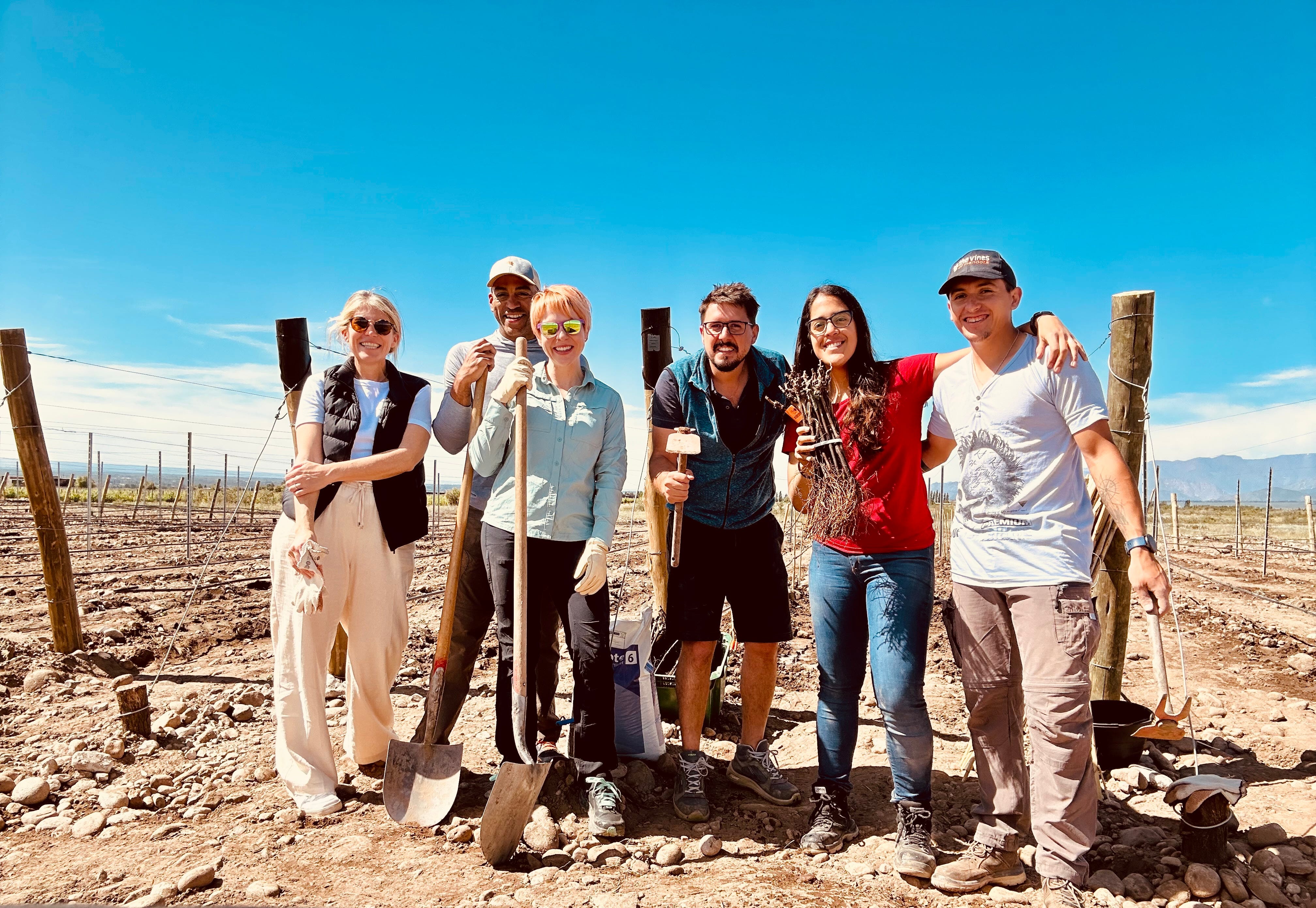
When the going gets tough, I recenter on the true north of this endeavor. The goosebumps I got when the opportunity arose. The tight hugs we shared standing on our land for the first time. The broad smile on LeVon’s face as we planted our first vines. The unbridled joy in Bekka and Nicole’s voices as they FaceTimed us from our fledgling vines. Beyond the details, the hurdles, and the bureaucracy, a stronger pull carries our efforts: joy, vision, love, and the belief in our shared dream.
Whatever your version of this looks like — your dream, your loved ones, your partners, your friends — the principle holds.
That’s the compass. That’s what carries you through the next step, whatever it turns out to be.