

In 2003, I took a feminist theory class at Vassar taught by a total badass. I think their name was Jamie. Their full name is lost to time and bad college decisions, but their presence is not. Black, thick-rimmed glasses paired with a rotating collection of ascot-tied silk scarves, and the cool confidence of someone standing firmly in who they are, regardless of what the world had to say about it. We were all more than a little in love with them.
Of the many feminist theory courses I took, this one centered on Donna Haraway’s A Cyborg Manifesto. When Haraway’s 1985 text was assigned to me in 2003, I had no idea I’d be living inside its questions in 2026.
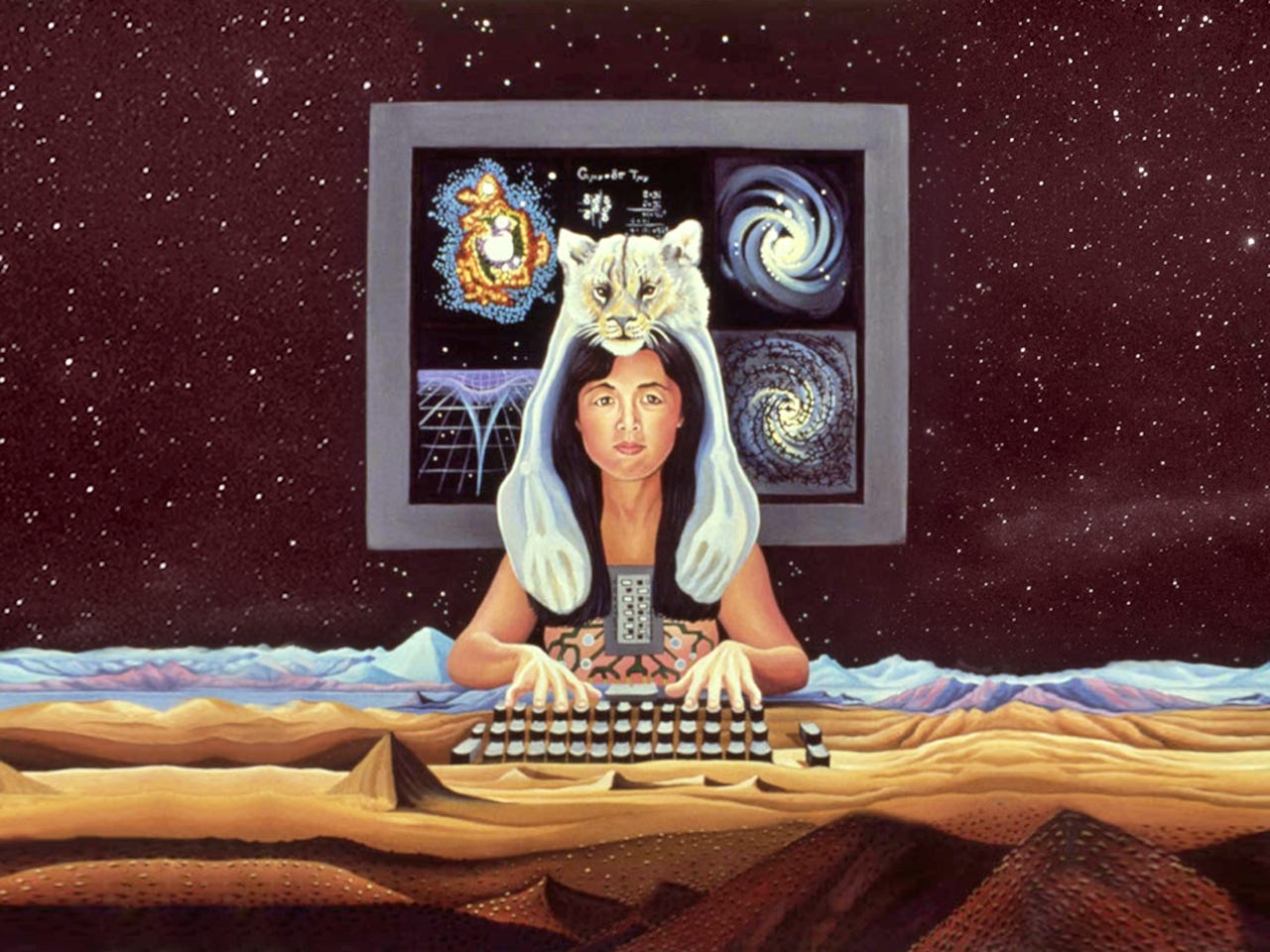
The tl;dr version of Haraway’s thesis: the boundaries between human and machine were dissolving and were bound to happen. The real question was: who would get to decide what the hybrid looked like. Whose body? Whose experience? Whose humanity would be centered in the design? Arnold Schwarzenegger gave us an early answer in The Terminator (which we also screened in this particular class; like I said, this professor was fucking cool).
Today, I’m reflecting on a week spent with my fourteen thousand closest friends at a tech conference: Adobe Summit. More than twenty years later, I’m still sitting with Haraway’s central question.
Big Stage Energy
Every year, Adobe Summit offers an unmatched opportunity to experience inspiring, sophisticated marketing technology evolutions. Agentic AI orchestrating entire personalized customer journeys. Internal workflows compressed from months to moments. On-brand creative iteration at unmatched scale. Complex data and insights surfacing from a single prompt. A marketer’s dream, rendered in high definition on a very large stage.
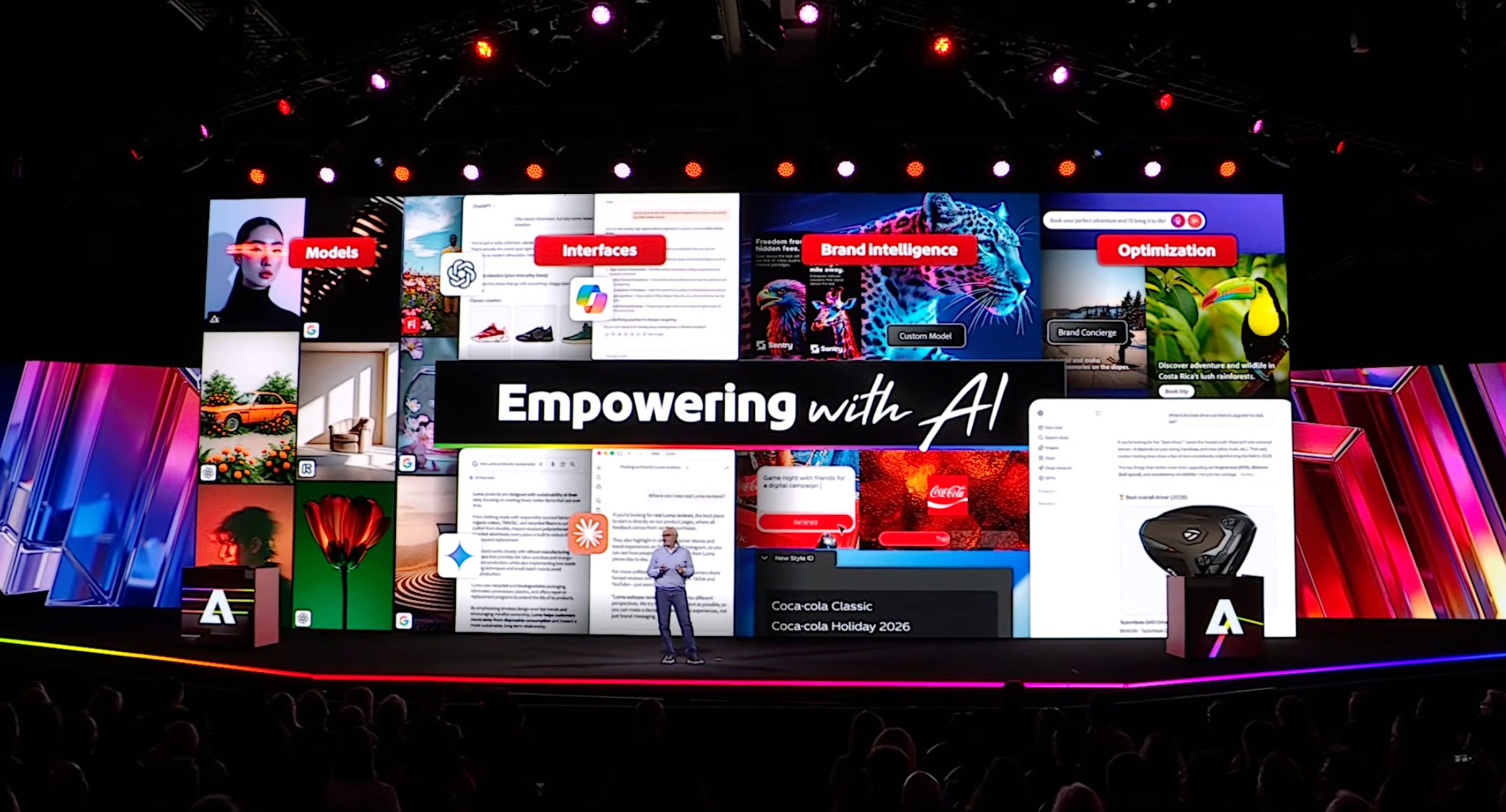
It’s energizing. It’s also something else, simultaneously.
The opening keynote began with Anil Chakravarthy, President of Adobe’s Customer Experience Orchestration Business — a man — who introduced Adobe CEO Shantanu Narayen — also a man — to deliver his final keynote of his 18-year tenure — who then introduced Jensen Huang, President and CEO of Nvidia — also a man — followed by David Wadhwani, President of Adobe’s Creativity and Productivity Business — also a man — who then introduced two women to run a product demo.
I’m not outlining this chronology to explore a well-worn, painfully true conversation about representation. I’m sharing a different kind of well-worn experience.
As I sat under the dazzling rainbow glow of Adobe’s graphics, I felt something in my body before I could place it in my mind. A tightening, surrounded by a twinge of anger, settling into a familiar discomfort. Women and underrepresented voices know this feeling in their bones. It’s the sensation of sitting inside a space that wasn’t crafted for you or with you, silently questioning whether you belong.
Behind The Curtain
Between sessions, I stumbled across a New York Times article by a fellow Vassar graduate and psychology professor, David DeSteno, titled Anthropic Wants Claude to Be Moral. Is Religion Really the Answer?. DeSteno’s article challenged Anthropic’s approach of leveraging religion to cultivate Claude’s morality. He argued that morality isn’t primarily cognitive, but is, rather, embodied. Religious and ethical practice is felt in the context of ritual, community, or physical experience. DeSteno applauded Anthropic’s intention to infuse morality into Claude, but noted that morality training might ultimately fail because Claude lacks something critical: a body.
Haraway would have had thoughts.
Later in the week, a colleague of mine, a woman driving hard in her career, was preparing to speak at an upcoming tech conference. She asked ChatGPT to help write her bio.
It assumed she was a man.
She pushed back. ChatGPT acknowledged its bias. The moment passed. But when she shared the experience with me, the familiar feeling I experienced in the Adobe keynote returned. The pit in my stomach. The tightening in my chest. I suspect she experienced her own version of these feelings.
The Body as Conductor
Here’s what I’m sitting with: leadership is embodied. Creativity is embodied. Belonging is embodied. It’s not a framework. It’s something you feel before you can name it.
And AI, by definition, doesn’t have a body.
More than that, the bodies that built and educated AI, and that now celebrate its productivity gains on sweeping stages, skew heavily in one direction. So, when we talk about AI learning and leading conversations rooted in morality, judgment, and creativity, whose embodied experience is AI actually learning from?
From the glitzy Adobe stage to the ChatGPT ghostwriter, I see the same embodied experience playing out in real time. These aren’t isolated glitches. They are a reflection of whose humanity has been most legibly absorbed, whose voice has been most codified, whose experience has been most architected into the tools that, so we’re told, are going to orchestrate our productivity, amplify our creativity, and reshape how we work.
In 1985, Haraway asked whose body was inside the machine. We’re still answering that question, but the answer I’d give today is not the answer I long for tomorrow.
Let me be clear: this isn’t a post about AI unconscious bias. That conversation is extremely important and is occurring with far more rigor than I can offer. If you want to go deeper, Newsweek’s coverage of AI’s misogyny maintenance hits home, as does Stanford Social Innovation Review’s take on the paradox of the AI gender gap.
I’m talking about something more personal.
My Embodied Truth
Recently, a friend shared an insight stuck with me. In a podcast she listened to, a female somatic psychologist shared this: when something keeps circling in your mind, when you can’t let it go, when it nags at you across days and weeks… that persistence is trauma raising its voice inside your body, asking to be heard.
For years, I’ve ruminated on my place as a woman and a leader in technology and consulting. Many times, I’ve felt the pang that stems from questioning my belonging. In the absence of clear answers, I’ve sought advice and perspective. I’ve sat with senior female leaders in technology, consulting and beyond to hear their stories and seek their counsel. I’ve absorbed their words as salves, as solutions, and as moments of feeling seen. Their perspectives have ranged from uplifting and encouraging to disappointing and subtly devastating. Despite hours of conversation and thought, the question remains.
But here’s what I do know: a deep well of strength resides within me, built from all that I’ve experienced in life. I have endured highs and lows that my body has synthesized into wisdom. The wisdom born of motherhood; of running a marathon; of deep heartache; of climbing fourteeners; of extended silent meditation; of pursuing a dream. The wisdom of these experiences accumulates in this body of mine and makes me who I am.
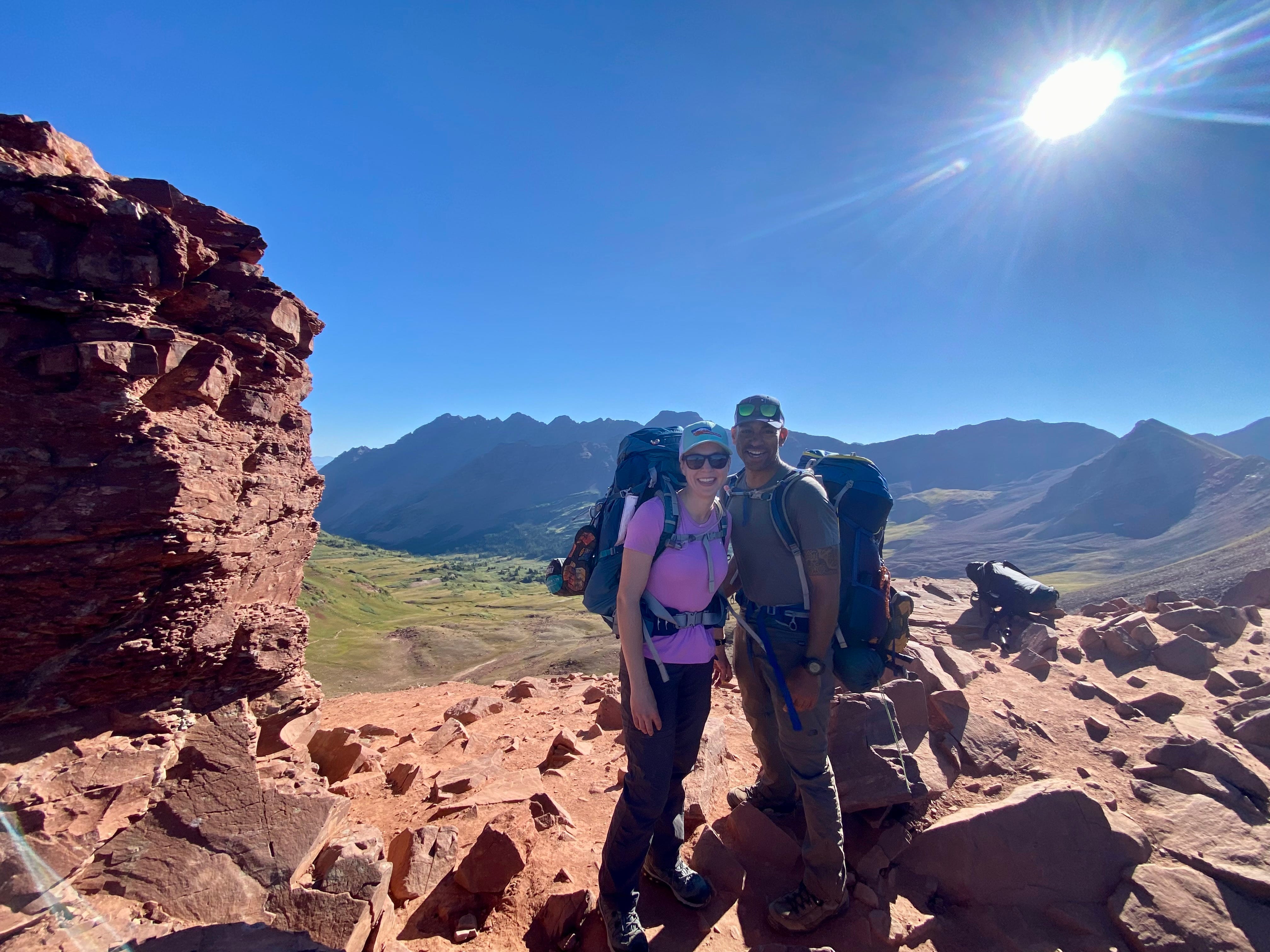
Yet, I regularly sit in spaces that don’t embody that power or, in the worst cases, actively diminish it. While I’m amazed by the ways marketing and technology are transforming, carving out new productivity gains, orchestrating new experiences, and upending the MarTech ecosystem, I can’t help but consider who these gains benefit most deeply.
I don’t have a tidy answer, but I don’t think I ever will.
Perhaps, just giving voice to the questions is enough. Perhaps, just speaking from what’s true inside myself is enough. Perhaps, in some small way, that physical act alone emboldens others to give voice to what’s true within themselves.
What’s the voice inside you that’s asking to be heard?
Lots of thoughts. Thanks for sharing yours, Kat!